
Live Data Performances and Projects

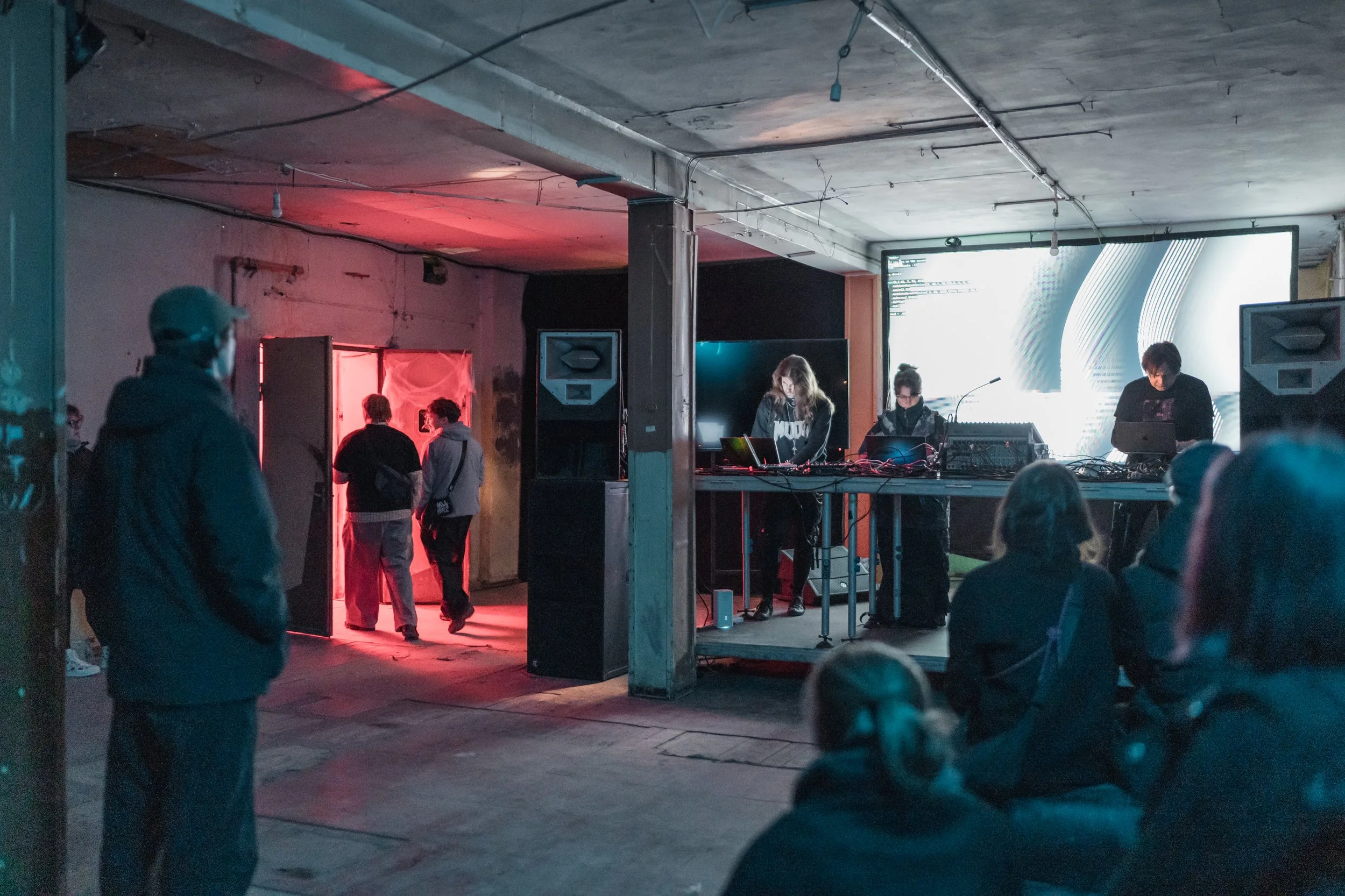
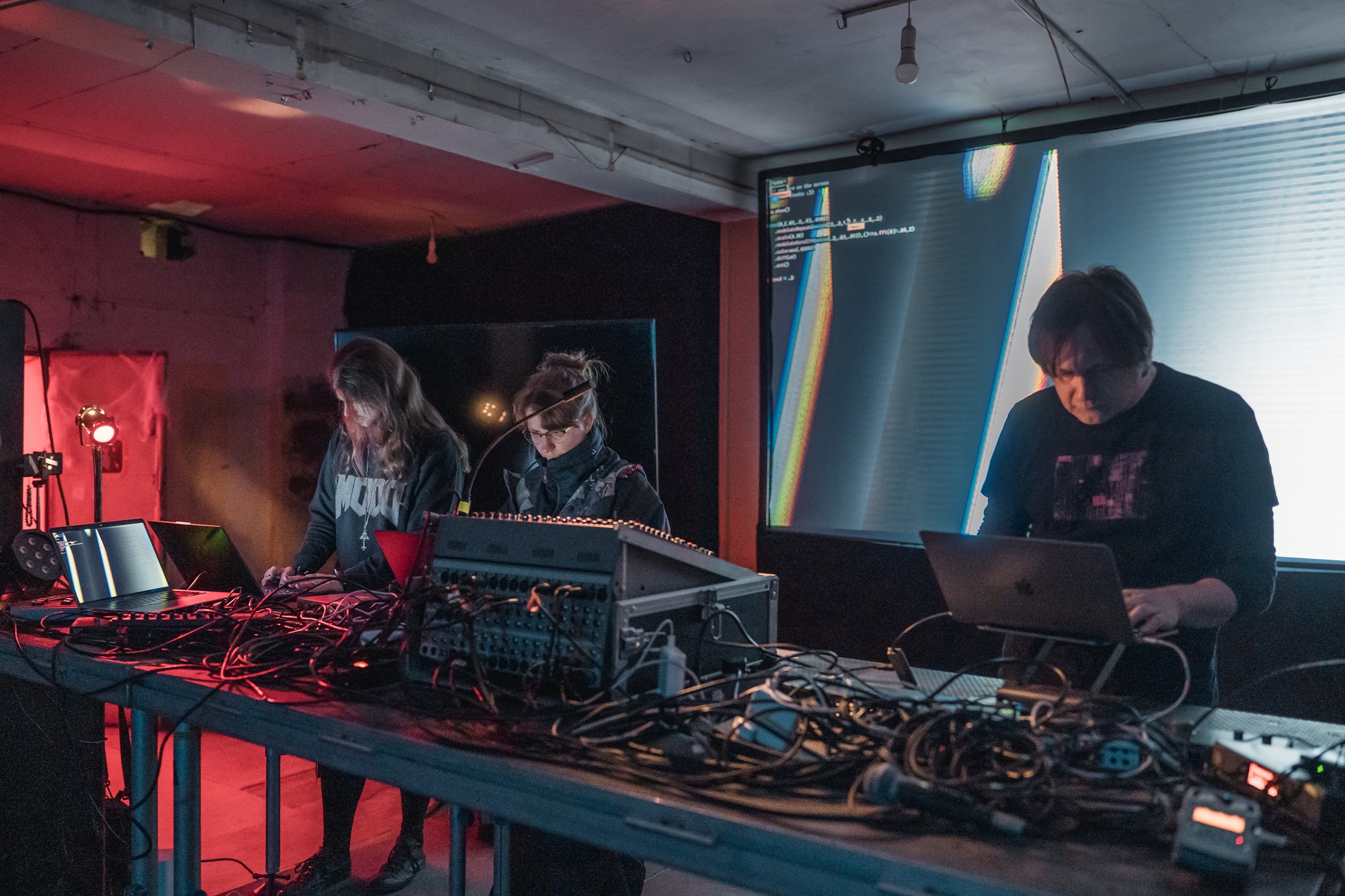
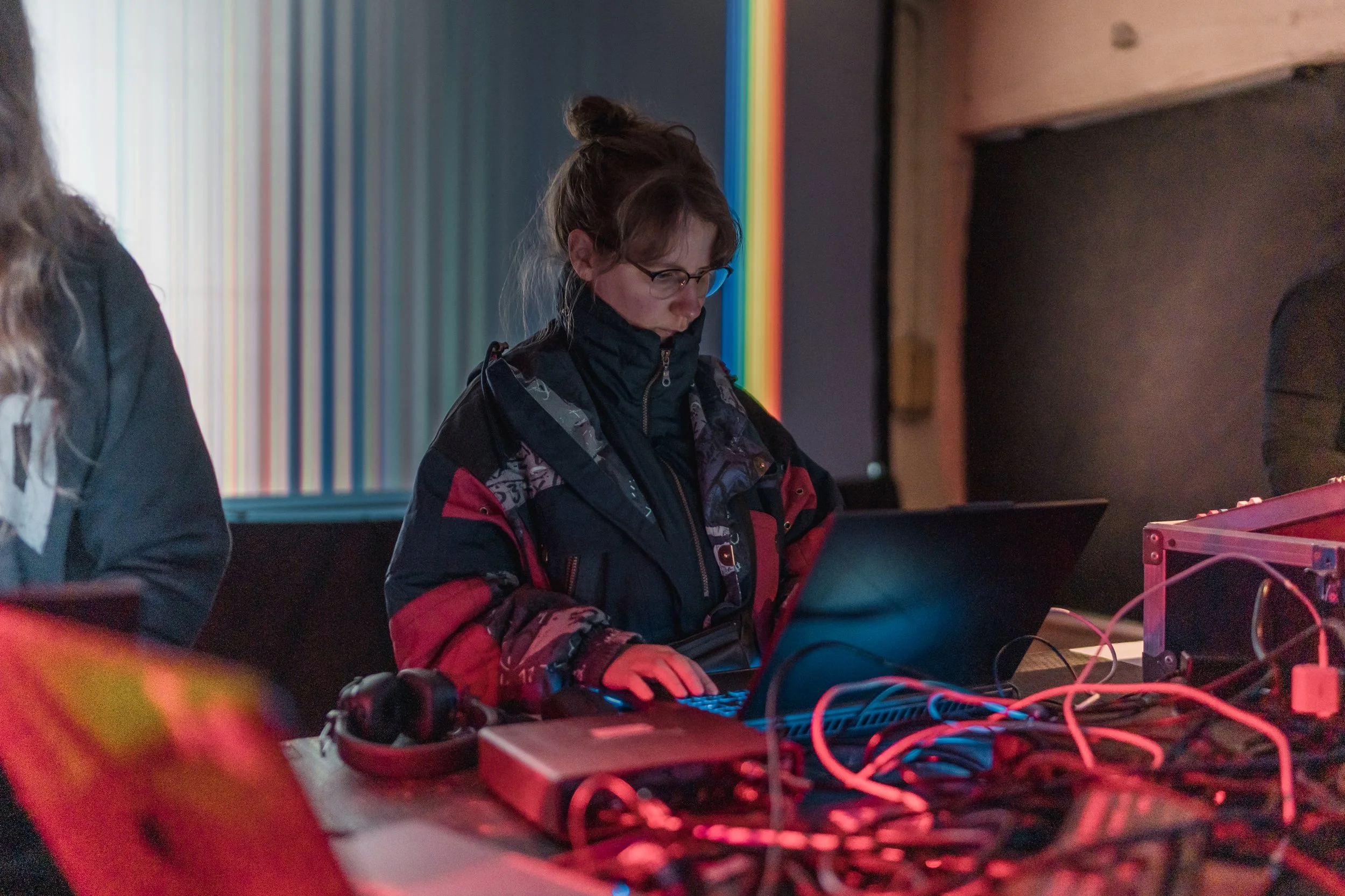
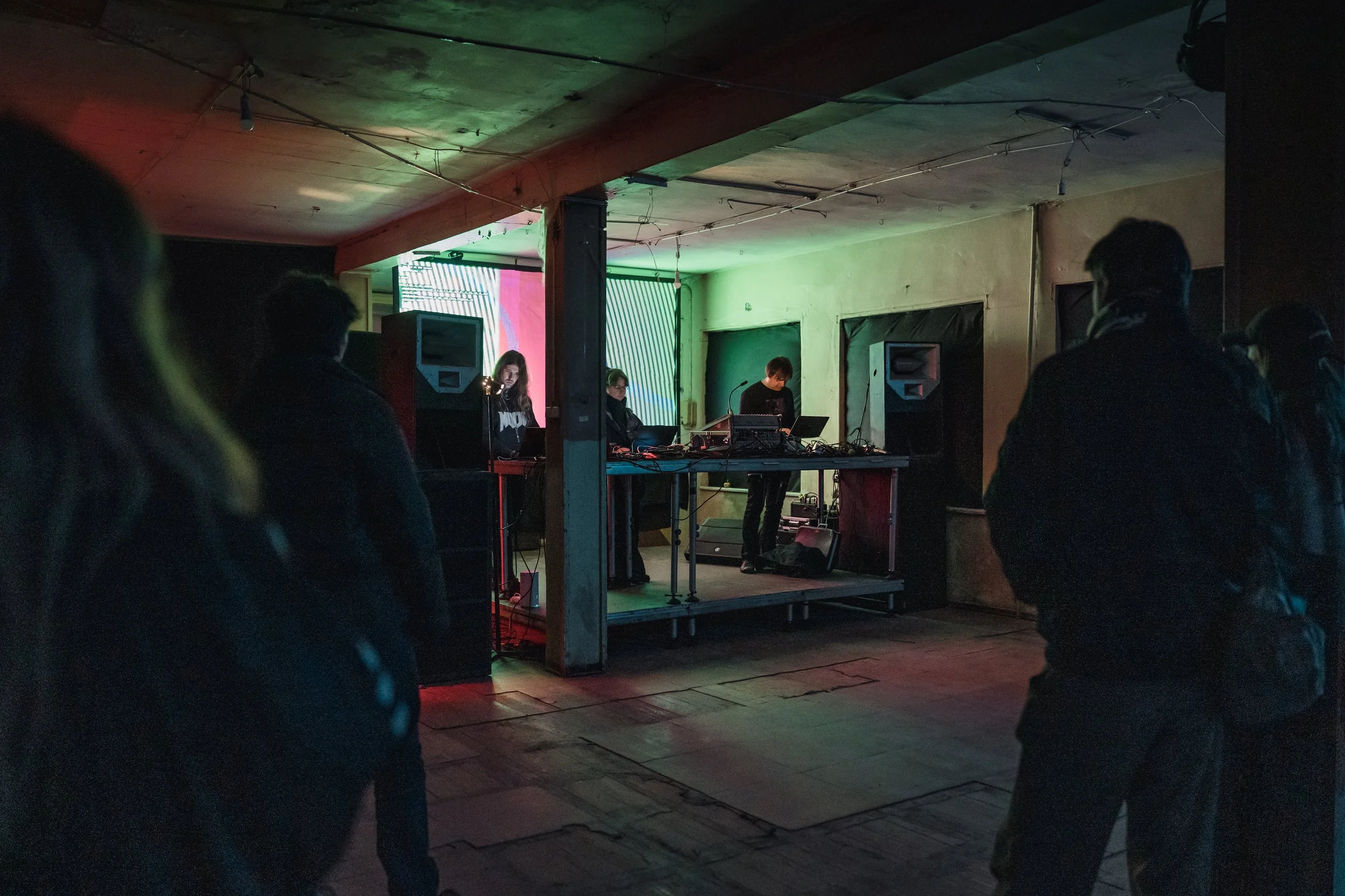
Photo by Karlis Volkovskis, 2025.
Live Coding visuals at Baltic Live Coders Meetup.
April 2025.
A jam session between Vygyntas Orlovas from Lithuania (using Pure Data - sound), Alise Rancāne from Latvia (using SuperCollider - sound), Alo Allik, who now lives in London but was born in Estonia (also using SuperCollider - sound) and myself, Kavi, born in Latvia and residing in Canada (hydra - visuals). In this performance, I connected remotely from Toronto, while the physical performance, featuring live coding music performers, took place in Liepaja, Latvia. My visuals were streamed and projected on the stage behind the musicians.
///My live coding MANIFESTO with Hydra visual programming tool///
there are two constants in my live coding universe with Hydra: the osc() and noise() functions. these two world-building materials correspond to two ideological constituents of movement and matter : :
osc() = oscillation/movement/vibration/reaction catalyst/rhythm
noise() = things/mattering/eruption of chaos/ordering
//////
How do i paint/draw with these essences?
first: simplicity
it is my solace, approach and place of peace
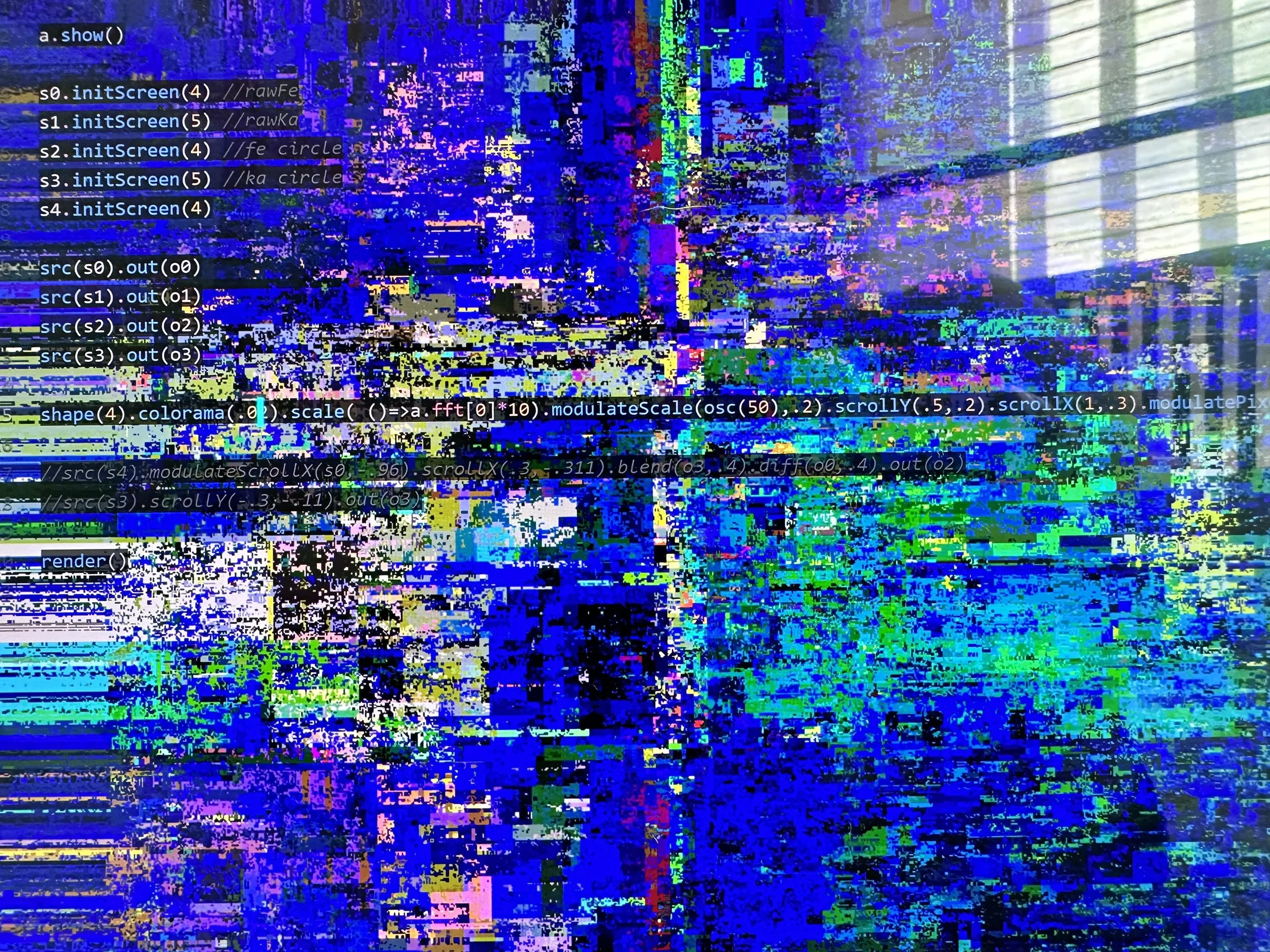
i am no programmer, but a hell of a live code explorer/pixel pusher/blunderer in bit universes. my goal and circumstances are to operate within small lines of code and dive deep into fractions that can go thousands of levels deep. a slight shift and change of 0.00522 to 0.29815 or 0.006831 completely redraws the universe, and that gives me a wild joy
second: scaling
scaling is our perception lens, a filter we continuously use to reference the world. it is also a window to outside humanly common landscapes: macro and micro. the scaling is also important and plays an essential role in the relationship building with other parameters, such as colorama(). through the tension between incremental scaling and colorama adjustments, one can paint inside the bounds of computer colour scheme of r-g-b with something that resembles a pixel rainbow instead
third: time&speed&expanded space
by slowing down the feedback, one can start to decipher the complexity unfolding, like taking a microscope to uncover the world within. a time is a sliding scale, nevertheless bound to internal computational clocks, it can be managed and shifted at live coder fingers. it is also an allowance of space for certain code artefacts to take place and linger, something that is whisked away inside computer world-clock @30fps or human eye refresh rate @60fps. by welcoming 2fps or sloooowwwweeeeeeeerrrrrrr, we can start to see the liminal spaces and inhabitants of pixel landscapes and inner dimensions



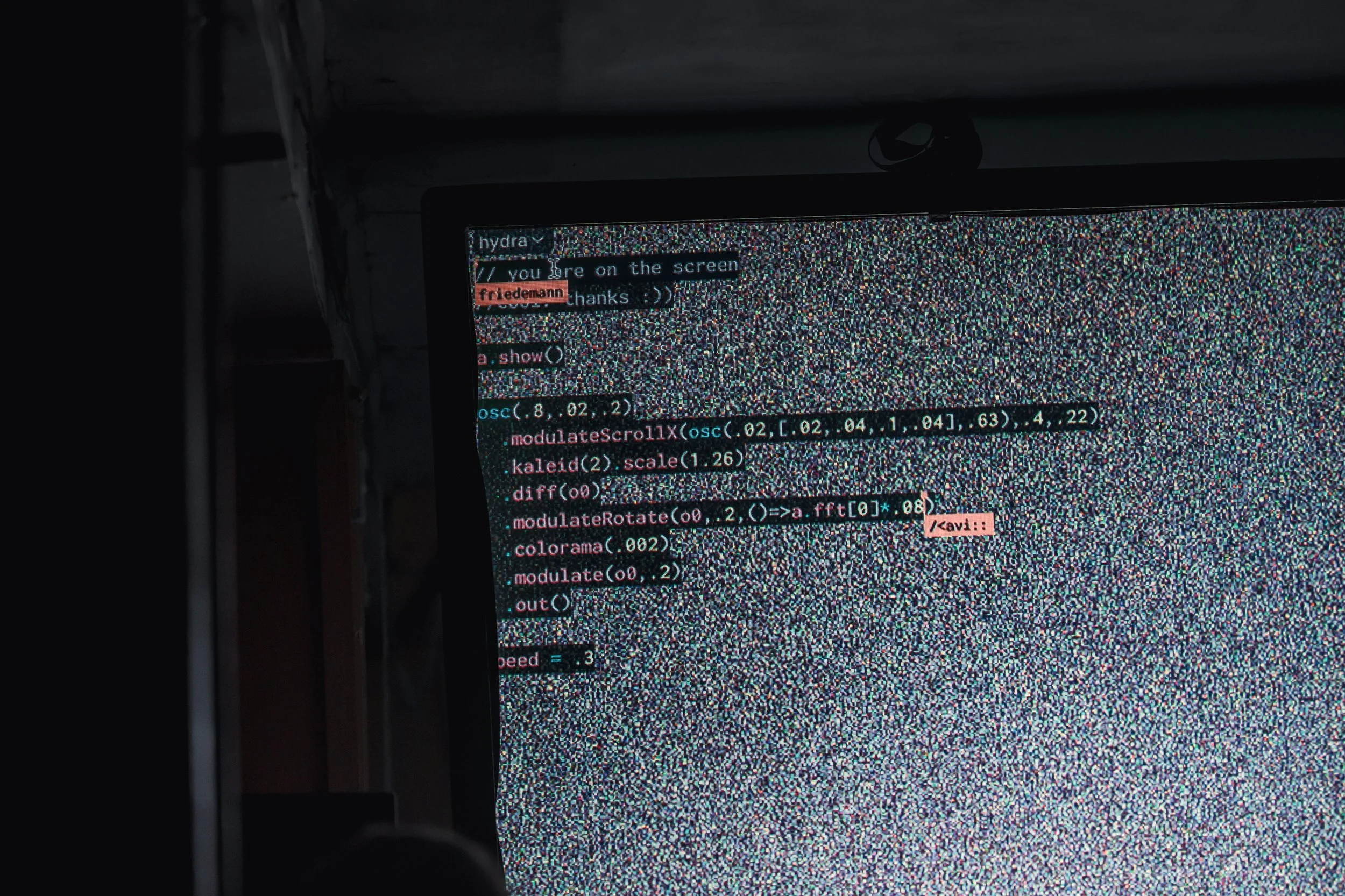
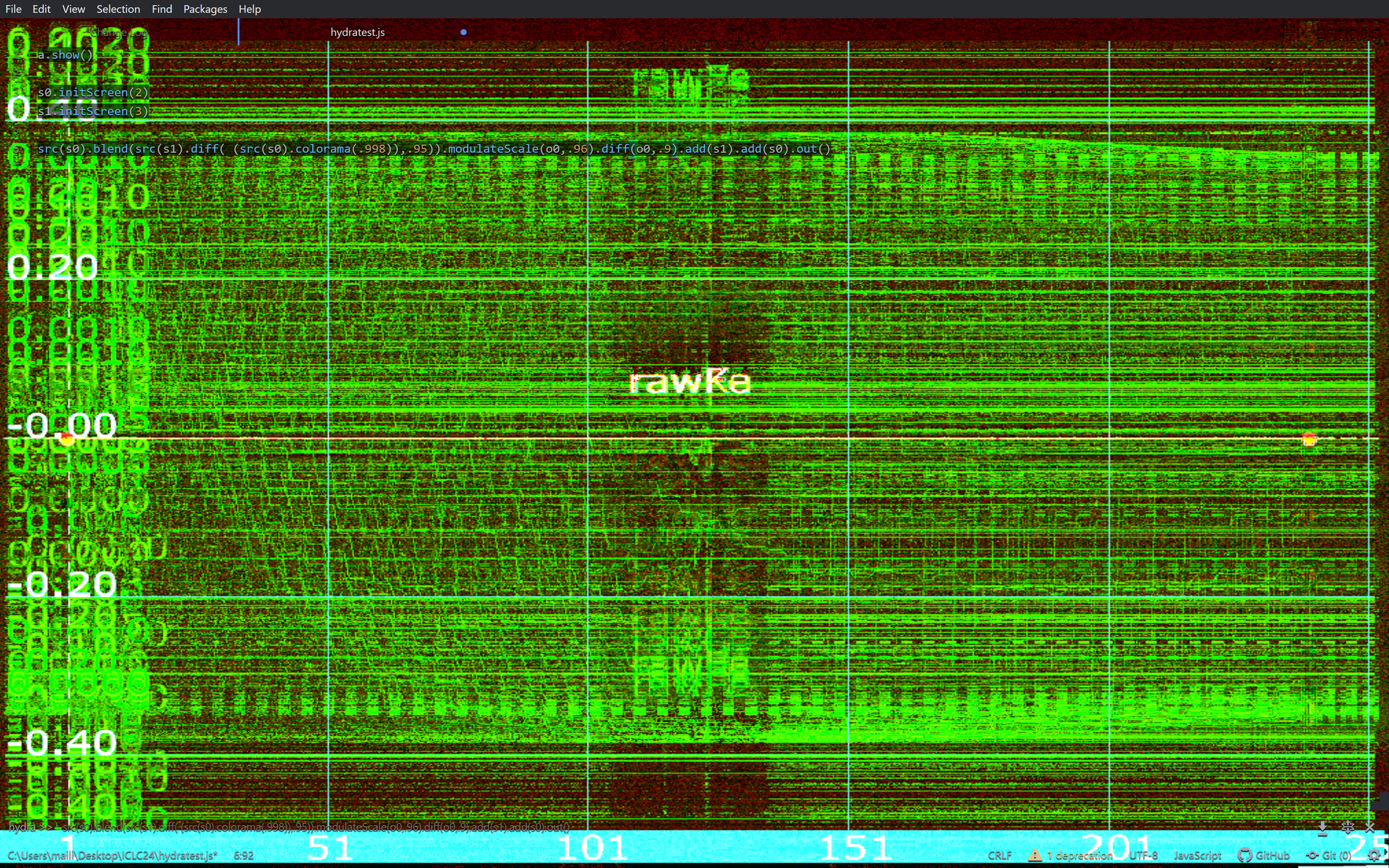
A screenshot of the visuals. Kavi, 2024.
Coiled Soma, live coding performance using the body’s physiological data.
May 2024.
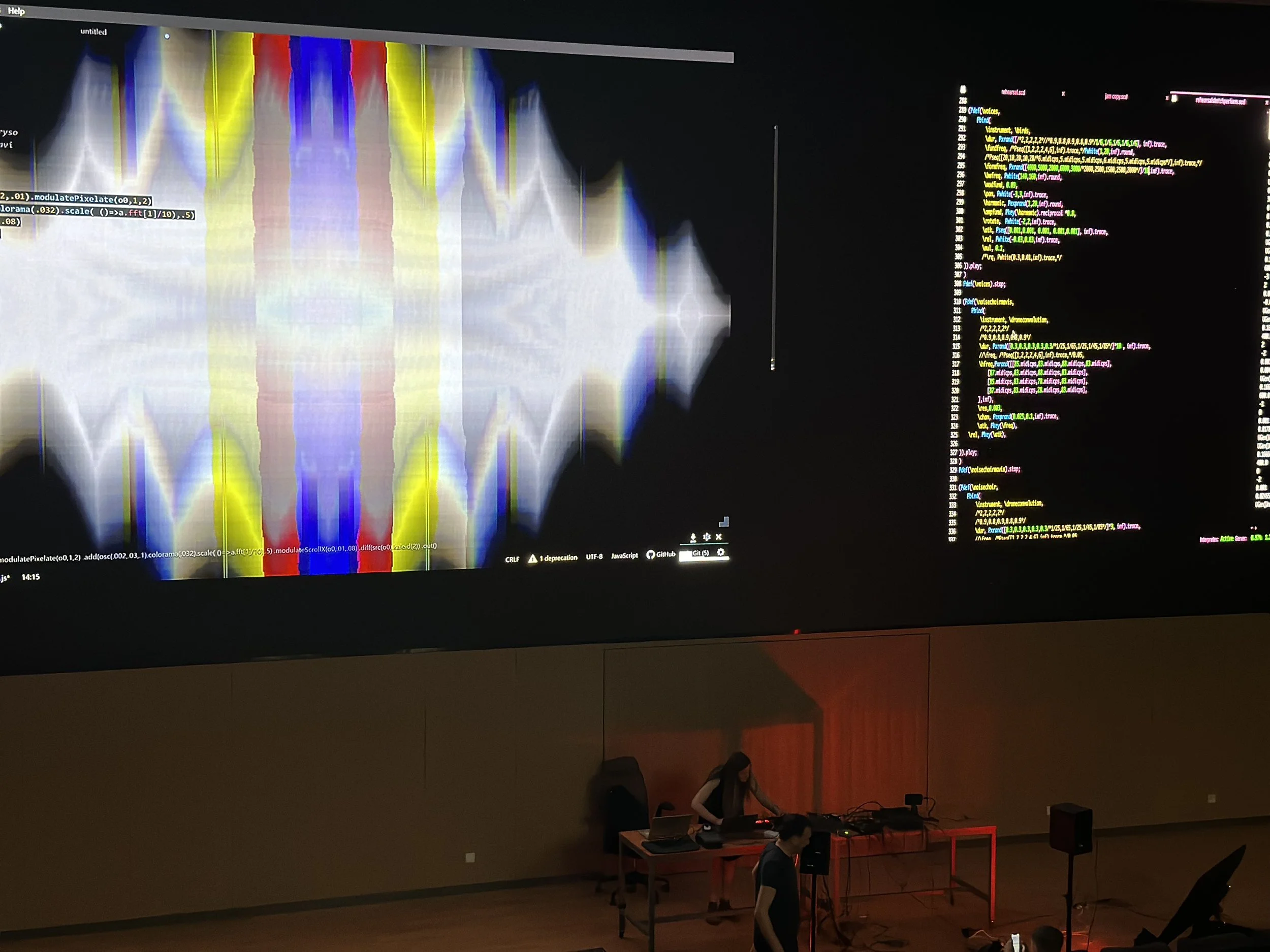
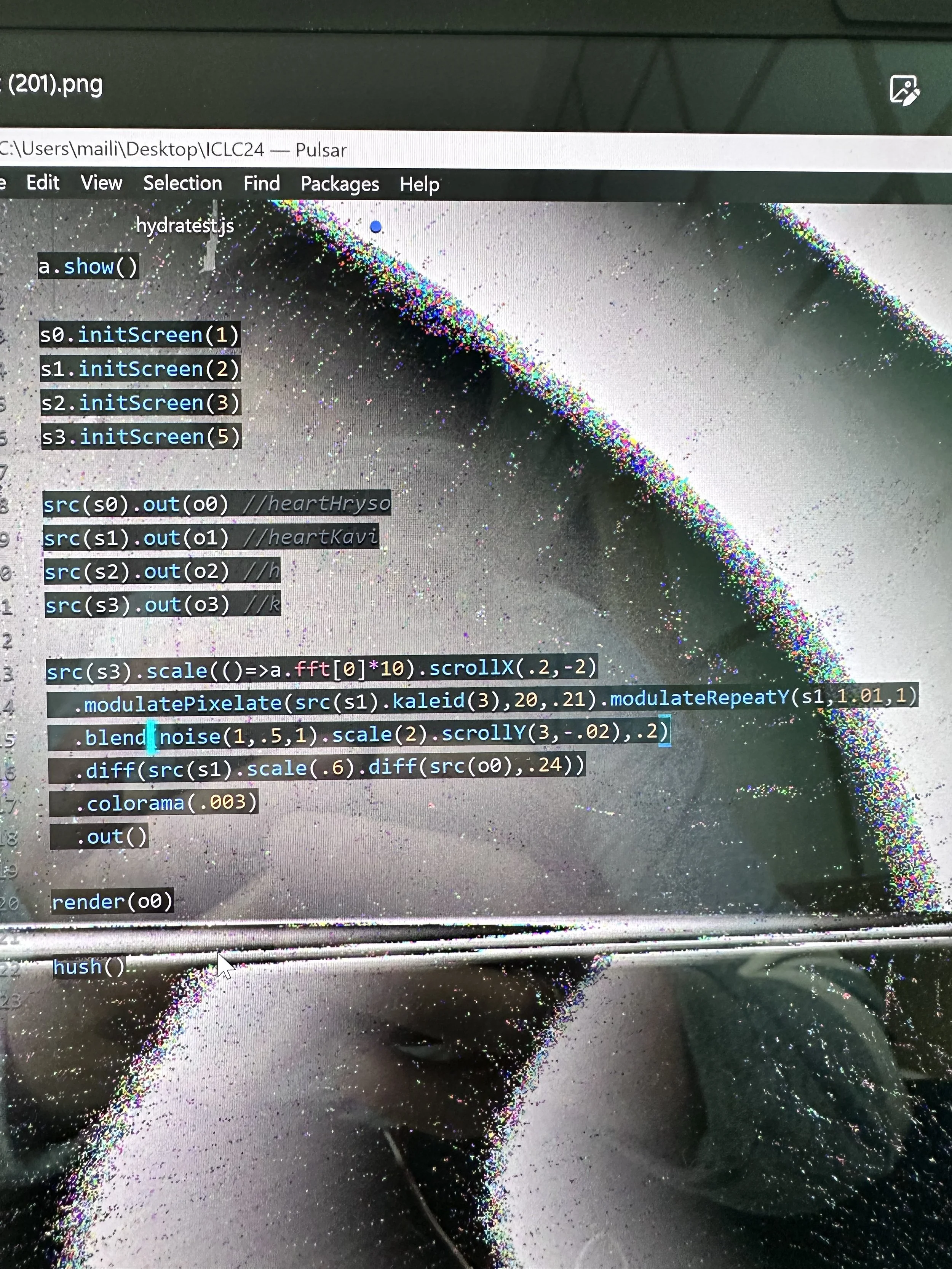
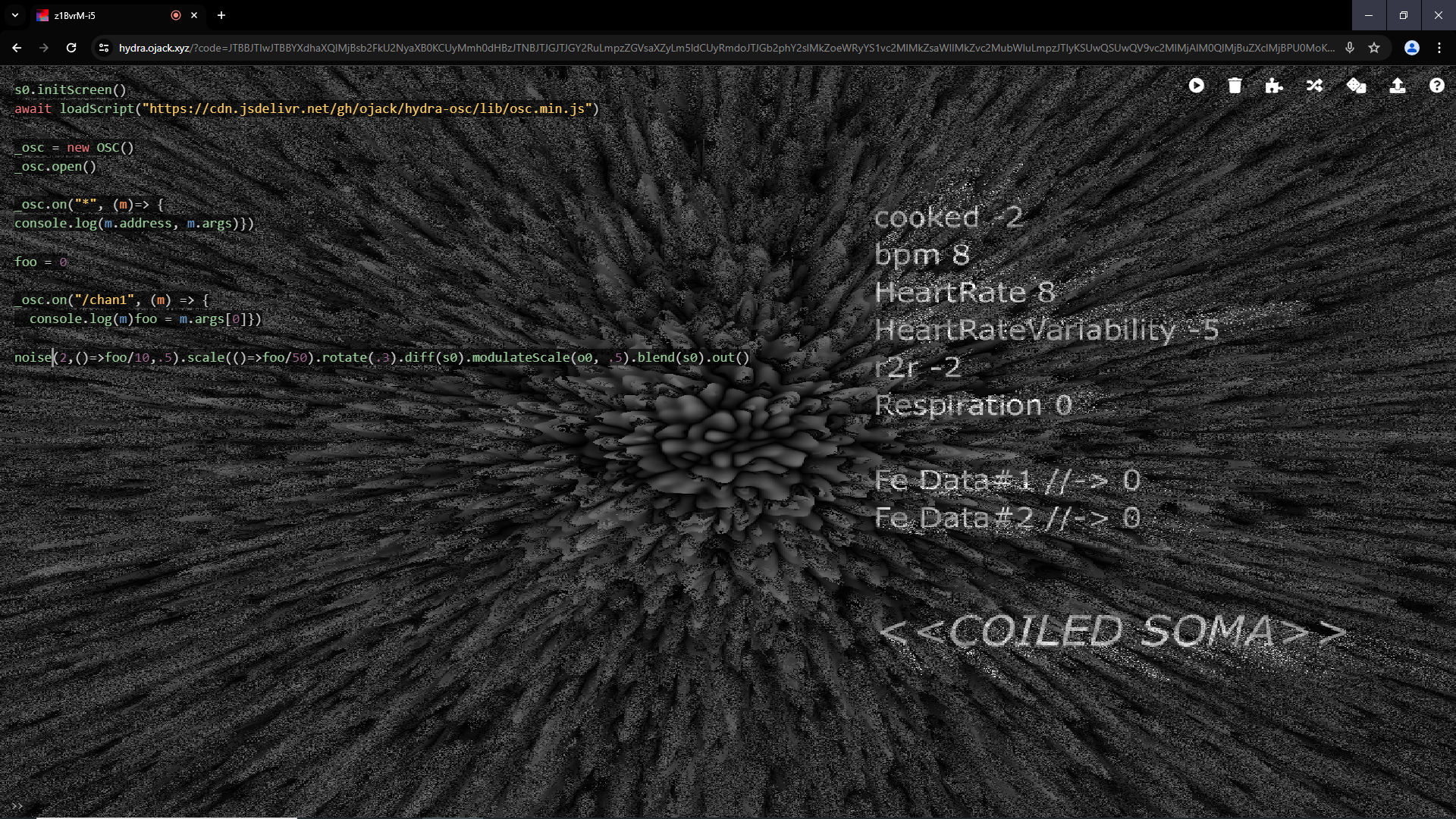
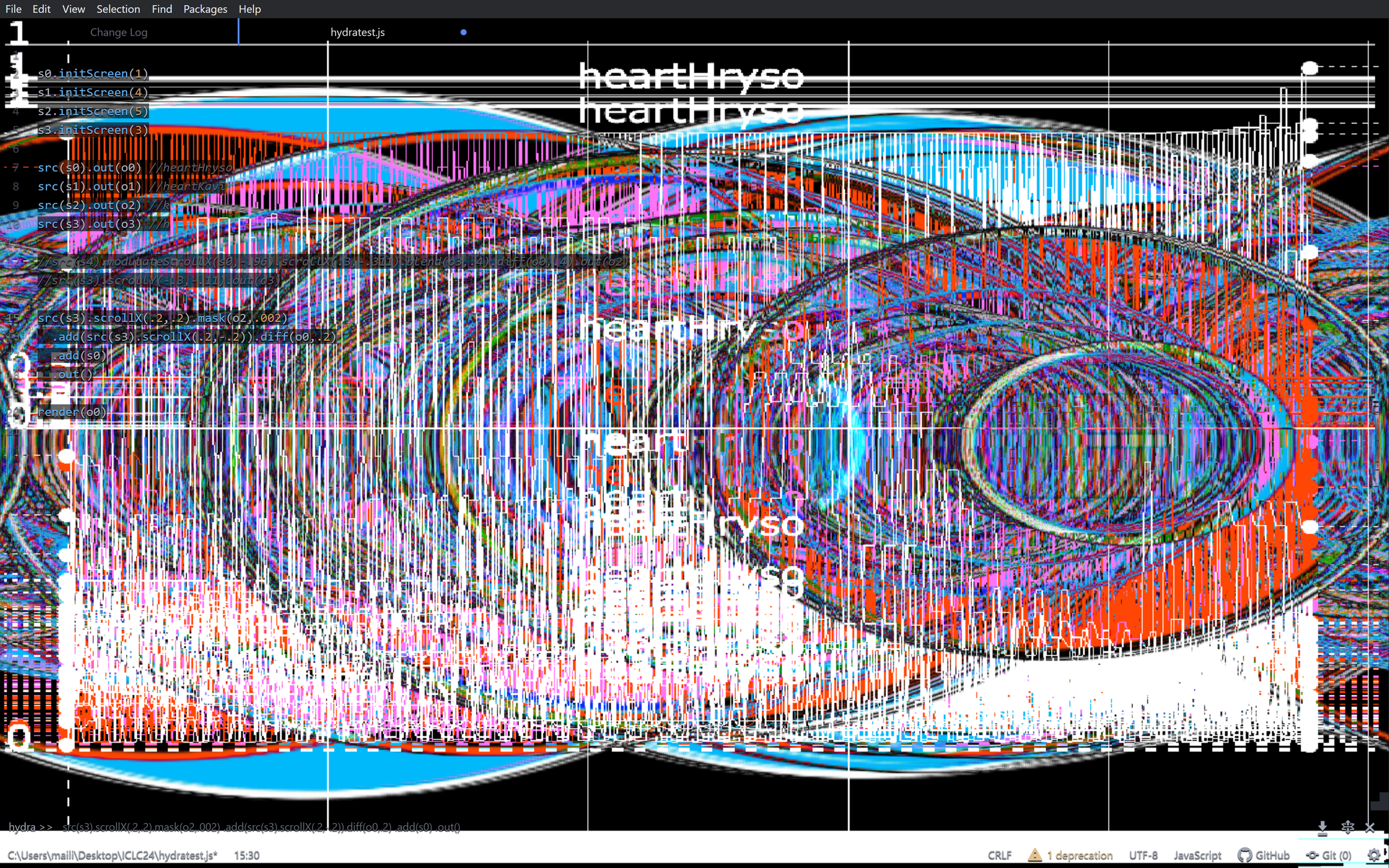
Coiled Soma is a collaborative performance between two artists: Hrysovalanti Maheras (sound - Supercollider) and Kavi (live coded visuals using Hydra and TouchDesigner), and was presented at The International Conference on Live Coding (ICLC) 2024 in Shanghai, China. This collaborative endeavour introduces an immersive, live-coded audiovisual experience that integrates biosensing technologies, particularly ECG heart activity data, enabling the extension of the body into the virtual and digital realms through data exchange and processing protocols. The approach in this performance pushes the boundaries of performing bodies, tapping into internal human processes as a source of creativity and beauty. Rooted in uncertainty and driven by the goal of evoking profound emotions, the performance strives to cultivate transparency and vulnerability via algorithmic interventions. Through collaborative efforts and intimate engagement, the artists aim to forge a deeper connection, emphasising clear and honest communication in their artistic expressions. This commitment extends beyond mere observation, fostering an atmosphere that facilitates a deeper and more meaningful connection between the performers and the audience.
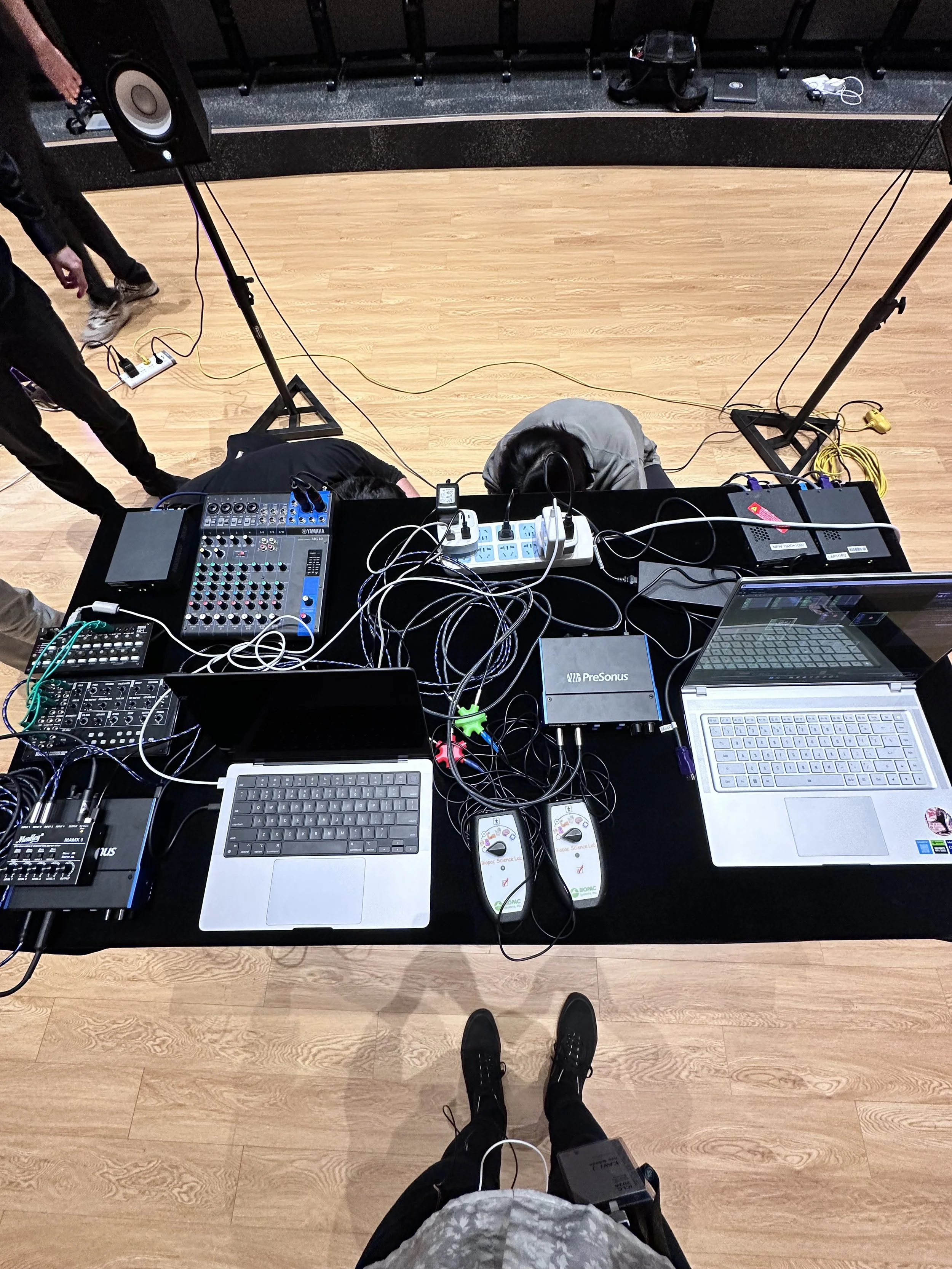
Our physical set-up included two BioMECI biophysiological sensing devices, developed by Mark-David Hosale and Alan Macy, coupled with Biopack’s MP40 sensors. We then used this data to inform our algorithm codes, while simultaneously exchanging information of our heart activities intermittently through visual and auditory modalities.

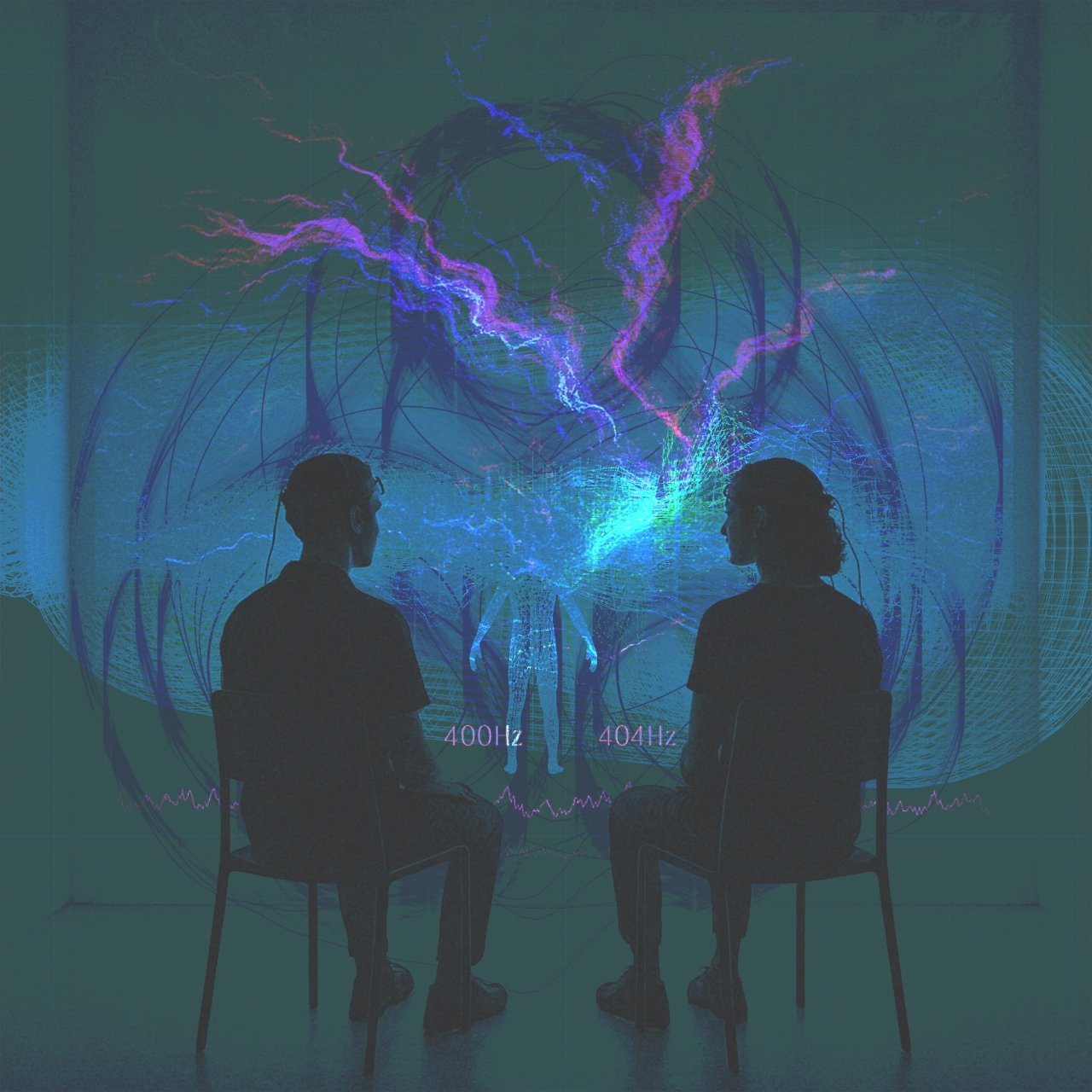
Proposed artwork prototype. Kavi, 2025.
404Hz: Resonances of Impermanence
In production, 2025.
404Hz: Resonances of Impermanence is a durational installation-performance exploring the fragile boundary between ephemeral cognition and digital decay. At the core of the work is a real-time brainwave interface involving two participants seated face-to-face, each equipped with EEG sensors. Their neural signals are translated into generative visuals and soundscapes, projected live onto a surrounding wall. The system is designed to self-degrade: visuals erode, glitch, and fragment over time, leaving behind only memories.
The project takes its name from the phenomenon of binaural beats. When participants hear tones of 400 Hz and 404 Hz in each ear, respectively, their brains perceive a 4 Hz difference, generating a beat in the delta frequency range (1–4 Hz), typically associated with deep sleep or unconscious states. This subtle mental entrainment prompts reflection on how machine processes can induce, reflect, or even simulate psychological states. While gamma brainwaves (30–100 Hz) correlate with heightened cognition and awareness, the 404 Hz beat references absence—an error code, a missing page, a lapse in memory.
Each 20-minute session is ephemeral and unarchived. Nothing is recorded. No artefact remains. The installation becomes a ritual of co-presence, a meditation on how we remember through bodies and machines, and how both decay.